Question 1
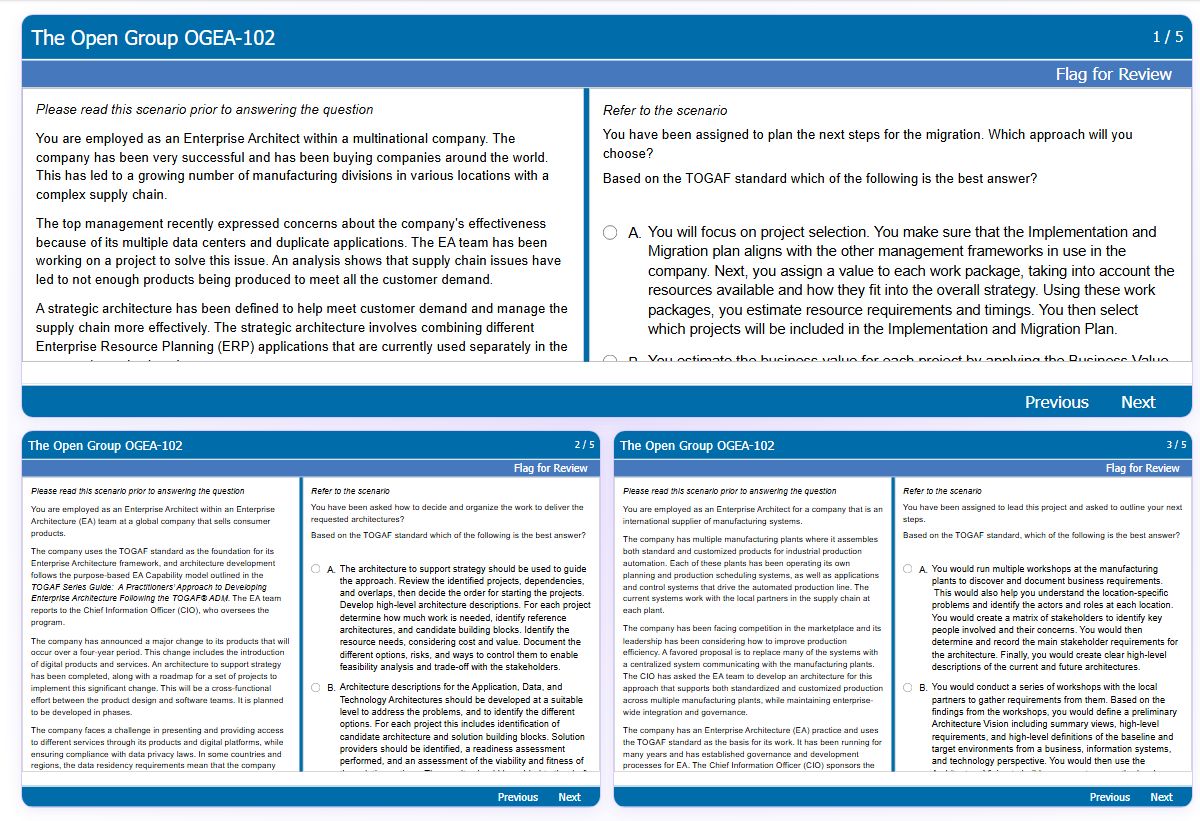
Refer to the scenario You have been assigned to plan the next steps for the migration. Which approach will you choose? Based on the TOGAF standard which of the following is the best answer? You finalize the Architecture Definition documentation with updates to reflect the implementation approach. You ensure that Implementation and Migration Plan is consistent with the chosen approach. You identify the resources needed to undertake the development projects. You would then produce an Implementation Governance Model to manage the lessons learned before finishing the plan. You ensure that the lessons learned are applied to the Implementation and Migration Plan. You finalize the Architecture Definition documentation with updates to reflect the implementation approach. You ensure that Implementation and Migration Plan is consistent with the chosen approach. You identify the resources needed to undertake the development projects. You would then produce an Implementation Governance Model to manage the lessons learned before finishing the plan. You ensure that the lessons learned are applied to the Implementation and Migration Plan. You estimate the business value for each project by applying the Business Value Assessment Technique to prioritize the migration projects and project steps. The assessment should focus on return on investment and criteria for evaluating performance to track the progress of the architecture transformation. You would confirm and plan a series of Transition Architecture phases using a table of Architecture Definition Increments that lists the projects. You then update the Implementation and Migration Plan. You estimate the business value for each project by applying the Business Value Assessment Technique to prioritize the migration projects and project steps. The assessment should focus on return on investment and criteria for evaluating performance to track the progress of the architecture transformation. You would confirm and plan a series of Transition Architecture phases using a table of Architecture Definition Increments that lists the projects. You then update the Implementation and Migration Plan. You will focus on project selection. You make sure that the Implementation and Migration plan aligns with the other management frameworks in use in the company. Next, you assign a value to each work package, taking into account the resources available and how they fit into the overall strategy. Using these work packages, you estimate resource requirements and timings. You then select which projects will be included in the Implementation and Migration Plan. You will focus on project selection. You make sure that the Implementation and Migration plan aligns with the other management frameworks in use in the company. Next, you assign a value to each work package, taking into account the resources available and how they fit into the overall strategy. Using these work packages, you estimate resource requirements and timings. You then select which projects will be included in the Implementation and Migration Plan. You conduct a series of Compliance Assessments to check that the architecture is being implemented as required by the contract. This is done now to confirm that the implementation team is following the correct development process, and if not, so course correction is viable. This involves using monitoring tools and making sure that performance targets are being achieved. If the targets are not met, you would then need to make adjustments to the performance requirements and update them in the Implementation and Migration Plan. You conduct a series of Compliance Assessments to check that the architecture is being implemented as required by the contract. This is done now to confirm that the implementation team is following the correct development process, and if not, so course correction is viable. This involves using monitoring tools and making sure that performance targets are being achieved. If the targets are not met, you would then need to make adjustments to the performance requirements and update them in the Implementation and Migration Plan. Question
Question 2
Refer to the scenario You have been asked how to decide and organize the work to deliver the requested architectures? Based on the TOGAF standard which of the following is the best answer? Architecture descriptions for the Application, Data, and Technology Architectures should be developed at a suitable level to address the problems, and to identify the different options. For each project this includes identification of candidate architecture and solution building blocks. Solution providers should be identified, a readiness assessment performed, and an assessment of the viability and fitness of the solution options. The results should be added to the draft Implementation and Migration plan. Architecture descriptions for the Application, Data, and Technology Architectures should be developed at a suitable level to address the problems, and to identify the different options. For each project this includes identification of candidate architecture and solution building blocks. Solution providers should be identified, a readiness assessment performed, and an assessment of the viability and fitness of the solution options. The results should be added to the draft Implementation and Migration plan. Start an iteration of ADM Phase A, perform a Stakeholder Analysis, identifying the key stakeholders and revising the Architecture Vision. Update the Stakeholder map created for the strategic architecture, so it reflects the stakeholders who are now the most important for the projects that are to be developed. Hold a formal review with the CTO, who should decide which projects to include in the Architecture Roadmap and update the Implementation and Migration Plan to reflect the decisions. Start an iteration of ADM Phase A, perform a Stakeholder Analysis, identifying the key stakeholders and revising the Architecture Vision. Update the Stakeholder map created for the strategic architecture, so it reflects the stakeholders who are now the most important for the projects that are to be developed. Hold a formal review with the CTO, who should decide which projects to include in the Architecture Roadmap and update the Implementation and Migration Plan to reflect the decisions. Follow a standard pattern for cloud solutions that manage complex data and that fits with the architecture to support strategy. Develop high-level Target Data, Application and Technology Architectures. Review the Architecture Vision to determine the level of detail, time, and scope of the ADM cycle phases required for architecture development for the project. Identify and estimate the cost of the main work packages. Create an Architecture Roadmap and request the Architecture Board to approve the roadmap. Start the project. Follow a standard pattern for cloud solutions that manage complex data and that fits with the architecture to support strategy. Develop high-level Target Data, Application and Technology Architectures. Review the Architecture Vision to determine the level of detail, time, and scope of the ADM cycle phases required for architecture development for the project. Identify and estimate the cost of the main work packages. Create an Architecture Roadmap and request the Architecture Board to approve the roadmap. Start the project. The architecture to support strategy should be used to guide the approach. Review the identified projects, dependencies, and overlaps, then decide the order for starting the projects. Develop high-level architecture descriptions. For each project determine how much work is needed, identify reference architectures, and candidate building blocks. Identify the resource needs, considering cost and value. Document the different options, risks, and ways to control them to enable feasibility analysis and trade-off with the stakeholders. The architecture to support strategy should be used to guide the approach. Review the identified projects, dependencies, and overlaps, then decide the order for starting the projects. Develop high-level architecture descriptions. For each project determine how much work is needed, identify reference architectures, and candidate building blocks. Identify the resource needs, considering cost and value. Document the different options, risks, and ways to control them to enable feasibility analysis and trade-off with the stakeholders. Question
Question 3
Refer to the scenario You have been assigned to lead this project and asked to outline your next steps. Based on the TOGAF standard, which of the following is the best answer? You would run a proof-of-concept project to allow your suppliers to demonstrate candidate off-the-shelf solutions that address the concerns of the stakeholders. After looking at the results of the project, you would select the most efficient solution and use that to set the requirements. Once the requirements are complete, there should be a formal stakeholder review, and permission requested to move forward to develop the Target Architecture. You would run a proof-of-concept project to allow your suppliers to demonstrate candidate off-the-shelf solutions that address the concerns of the stakeholders. After looking at the results of the project, you would select the most efficient solution and use that to set the requirements. Once the requirements are complete, there should be a formal stakeholder review, and permission requested to move forward to develop the Target Architecture. You would run multiple workshops at the manufacturing plants to discover and document business requirements. This would also help you understand the location-specific problems and identify the actors and roles at each location. You would create a matrix of stakeholders to identify key people involved and their concerns. You would then determine and record the main stakeholder requirements for the architecture. Finally, you would create clear high-level descriptions of the current and future architectures. You would run multiple workshops at the manufacturing plants to discover and document business requirements. This would also help you understand the location-specific problems and identify the actors and roles at each location. You would create a matrix of stakeholders to identify key people involved and their concerns. You would then determine and record the main stakeholder requirements for the architecture. Finally, you would create clear high-level descriptions of the current and future architectures. You would conduct a series of workshops with the local partners to gather requirements from them. Based on the findings from the workshops, you would define a preliminary Architecture Vision including summary views, high-level requirements, and high-level definitions of the baseline and target environments from a business, information systems, and technology perspective. You would then use the Architecture Vision to build agreement among the local partners. You would conduct a series of workshops with the local partners to gather requirements from them. Based on the findings from the workshops, you would define a preliminary Architecture Vision including summary views, high-level requirements, and high-level definitions of the baseline and target environments from a business, information systems, and technology perspective. You would then use the Architecture Vision to build agreement among the local partners. You would create high level views of the baseline and target Architectures for each manufacturing plant, and then a set of views corresponding to selected viewpoints to address key concerns of the stakeholders. The gap analysis results for the architectures should be reviewed and consolidated into a single list. A set of work packages should be identified. A formal stakeholder review should be held to obtain approval before moving to the Target Architecture phase. You would create high level views of the baseline and target Architectures for each manufacturing plant, and then a set of views corresponding to selected viewpoints to address key concerns of the stakeholders. The gap analysis results for the architectures should be reviewed and consolidated into a single list. A set of work packages should be identified. A formal stakeholder review should be held to obtain approval before moving to the Target Architecture phase. Question
Question 4
Refer to the scenario The EA team leader has asked you for the best way to address the Chief Engineer's concern. Based on the TOGAF standard, which of the following is the best answer? The contracts must be checked to ensure they have flexibility. There must be a legal contract in place for all changes assigned to be made by contractors. There must be a memorandum of understanding between the Architecture Board and the implementation organization for changes made by internal teams. If the implementation organization needs to customize the process to meet their local needs, the Architecture Board will grant a dispensation to allow deviation from the contract. The contracts must be checked to ensure they have flexibility. There must be a legal contract in place for all changes assigned to be made by contractors. There must be a memorandum of understanding between the Architecture Board and the implementation organization for changes made by internal teams. If the implementation organization needs to customize the process to meet their local needs, the Architecture Board will grant a dispensation to allow deviation from the contract. The contracts must specify goals, measures, acceptance terms, and risks. Third-party contracts need to be legally enforceable. There needs to be a schedule of compliance reviews at key points in the implementation process. The Architecture Board must review all deviations from the Architecture Contract. The Architecture Board must consider whether to grant a dispensation to allow the process to be customized for local needs. Establish a dispute resolution mechanism for issues not resolved through the compliance and dispensation processes. The contracts must specify goals, measures, acceptance terms, and risks. Third-party contracts need to be legally enforceable. There needs to be a schedule of compliance reviews at key points in the implementation process. The Architecture Board must review all deviations from the Architecture Contract. The Architecture Board must consider whether to grant a dispensation to allow the process to be customized for local needs. Establish a dispute resolution mechanism for issues not resolved through the compliance and dispensation processes. The contracts must be checked to ensure they can direct and control the implementation teams. There must be a memorandum of understanding between the Architecture Board and the implementation organization for project work undertaken by an internal team. There must be fully enforceable legal contracts for any contracts issued to third-party contractors. The Architecture Board must review all deviations from the Architecture Contract and decide if to grant a dispensation to allow the implementation organization to customize the process to meet their local needs. The contracts must be checked to ensure they can direct and control the implementation teams. There must be a memorandum of understanding between the Architecture Board and the implementation organization for project work undertaken by an internal team. There must be fully enforceable legal contracts for any contracts issued to third-party contractors. The Architecture Board must review all deviations from the Architecture Contract and decide if to grant a dispensation to allow the implementation organization to customize the process to meet their local needs. The contracts must be used to manage the architecture governance processes across the locations. Monitoring tools will be used to assess the performance of each completed battery pack at each location and used to identify the change requirements if necessary. If a deviation from the contract is needed to meet local needs, the Architecture Board should allow the Architecture Contract to be modified. In such cases the Architecture Board must issue a new Request for Architecture Work to implement a modification to the Architecture Definition. The contracts must be used to manage the architecture governance processes across the locations. Monitoring tools will be used to assess the performance of each completed battery pack at each location and used to identify the change requirements if necessary. If a deviation from the contract is needed to meet local needs, the Architecture Board should allow the Architecture Contract to be modified. In such cases the Architecture Board must issue a new Request for Architecture Work to implement a modification to the Architecture Definition. Question
Question 5
Refer to the scenario You have been asked how you will address risk and security at this stage of the architecture project. Based on the TOGAF standard which of the following is the best answer? A qualitative risk assessment should be carried out for the data assets exchanged with the service providers. This will deliver a set of priorities, high to medium to low, based on identified threats, the likelihood of occurrence, and the impact. Using the priorities, a Business Risk Model can then be developed detailing the risk strategy including classifications to determine what mitigation is sufficient. This model can then used to determine the risk strategy for the company. A qualitative risk assessment should be carried out for the data assets exchanged with the service providers. This will deliver a set of priorities, high to medium to low, based on identified threats, the likelihood of occurrence, and the impact. Using the priorities, a Business Risk Model can then be developed detailing the risk strategy including classifications to determine what mitigation is sufficient. This model can then used to determine the risk strategy for the company. Since data is being shared across multiple service providers, a security federation should be established. This includes contractual arrangements, and a definition of the responsibility areas for the data exchanged, as well as security implications. Assets with the same security criteria should be grouped together so they can be managed under one security policy. A risk assessment should be carried out to determine the risks relevant to specific data assets. Since data is being shared across multiple service providers, a security federation should be established. This includes contractual arrangements, and a definition of the responsibility areas for the data exchanged, as well as security implications. Assets with the same security criteria should be grouped together so they can be managed under one security policy. A risk assessment should be carried out to determine the risks relevant to specific data assets. A trust framework should be established with the third parties required for the travel assistance systems. This will describe the relationship with each party and establish the foundation for secure cloud operations. Digital certificates should be a key part of the framework and will be used to create trust between the parties. Regular monitoring for legal and regulatory changes across all the countries should occur to keep the trust framework in compliance. A trust framework should be established with the third parties required for the travel assistance systems. This will describe the relationship with each party and establish the foundation for secure cloud operations. Digital certificates should be a key part of the framework and will be used to create trust between the parties. Regular monitoring for legal and regulatory changes across all the countries should occur to keep the trust framework in compliance. Data quality is a key factor in risk management. The datasets that need to be safeguarded should be identified. For each dataset, ownership and responsibility for the quality of data should be assigned. A security classification will be defined and applied to each dataset. The dataset owner will then be able to authorize processes that are trusted for a certain activity on the dataset under specific circumstances. Data quality is a key factor in risk management. The datasets that need to be safeguarded should be identified. For each dataset, ownership and responsibility for the quality of data should be assigned. A security classification will be defined and applied to each dataset. The dataset owner will then be able to authorize processes that are trusted for a certain activity on the dataset under specific circumstances. Question
Question 6
Refer to the Scenario In addition to Business Continuity, which Architecture Principles do you consider most relevant for guiding the transformation? Based on the TOGAF standard, which of the following is the best answer? [Note: The sequence of the principles listed in each answer does not matter. You should assume the company follows the example set of principles that are provided in the TOGAF standard, ADM Techniques, Architecture Principles chapter.] Common Vocabulary and Data Definitions, Compliance with the Law, Requirements Based Change, Data Security Common Vocabulary and Data Definitions, Compliance with the Law, Requirements Based Change, Data Security Common Use Applications, Data is an Asset, Data is Accessible, Ease of Use Common Use Applications, Data is an Asset, Data is Accessible, Ease of Use Control Technical Diversity, Interoperability, Data Trustee, Data is Shared Control Technical Diversity, Interoperability, Data Trustee, Data is Shared Maximize Benefit to the Enterprise, Common Use Applications, Responsive Change Management, Technology Independence Maximize Benefit to the Enterprise, Common Use Applications, Responsive Change Management, Technology Independence Question