
logo

The Open Group OGEA-103 Exam Questions & Verified Answers

Prepare for TOGAF Enterprise Architecture Combined Part 1 and Part 2 with expert-reviewed OGEA-103 questions and answers. Try free samples, strengthen your understanding and rehearse your timing in the simulator.

180
Practice questions
Previews from the TOGAF OGEA-103 free simulator sample

Try Free OGEA-103 Practice Questions

Explore the questions below, browse the question library or try a free five-question simulator sample to find the study format that works for you.

View 90 free questions
Question 1
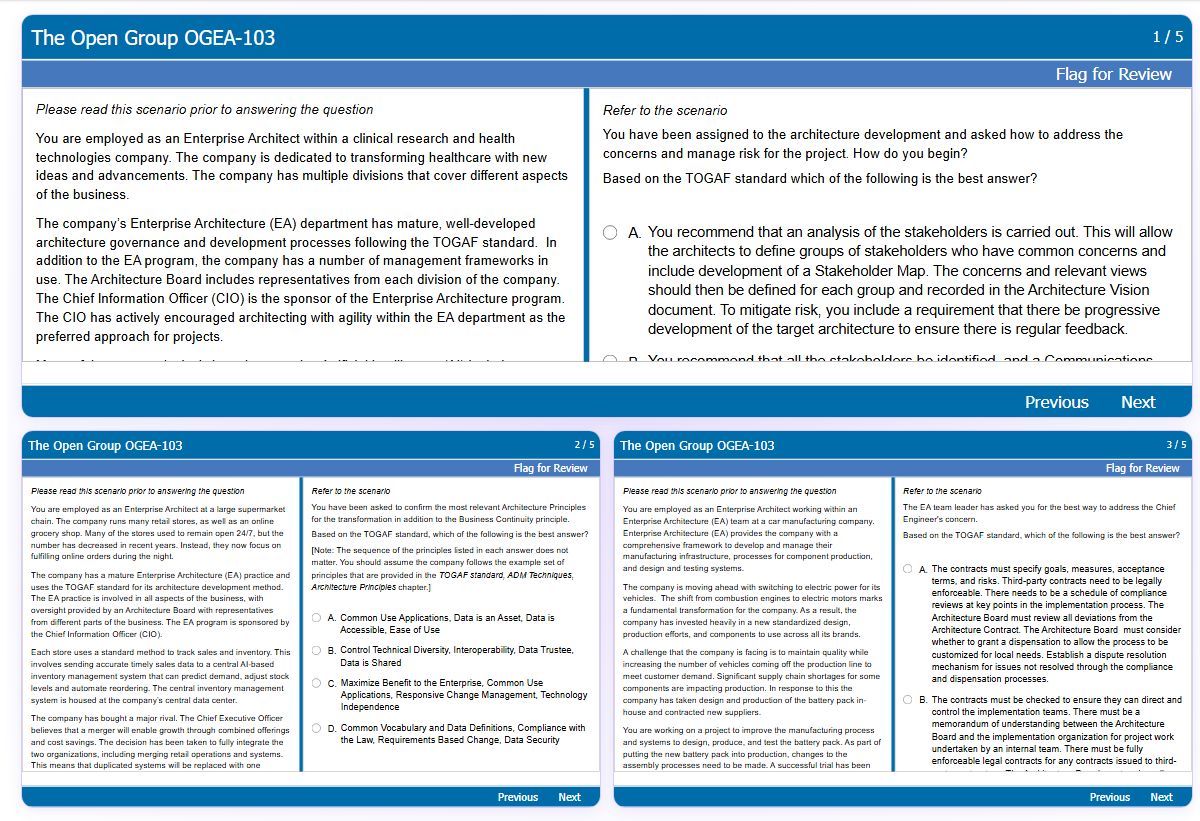
Refer to the scenario You have been assigned to the architecture development and asked how to address the concerns and manage risk for the project. How do you begin? Based on the TOGAF standard which of the following is the best answer? You recommend that an analysis of the stakeholders is carried out. This will allow the architects to define groups of stakeholders who have common concerns and include development of a Stakeholder Map. The concerns and relevant views should then be defined for each group and recorded in the Architecture Vision document. To mitigate risk, you include a requirement that there be progressive development of the target architecture to ensure there is regular feedback. You recommend that an analysis of the stakeholders is carried out. This will allow the architects to define groups of stakeholders who have common concerns and include development of a Stakeholder Map. The concerns and relevant views should then be defined for each group and recorded in the Architecture Vision document. To mitigate risk, you include a requirement that there be progressive development of the target architecture to ensure there is regular feedback. You recommend creation of a simple solution concept diagram to show how the stakeholders will be impacted, and the benefits to the firm. You would also create a benefits diagram showing the various opportunities from adoption of AI-based solutions. A meeting should be held with the main stakeholders to review the diagrams. They can then decide the priorities and sequencing decisions for the architecture development. Risk will be evaluated when defining the Architecture Roadmap. You recommend creation of a simple solution concept diagram to show how the stakeholders will be impacted, and the benefits to the firm. You would also create a benefits diagram showing the various opportunities from adoption of AI-based solutions. A meeting should be held with the main stakeholders to review the diagrams. They can then decide the priorities and sequencing decisions for the architecture development. Risk will be evaluated when defining the Architecture Roadmap. You recommend that models be created for the Draft Business, Data, Application, and Technology Architectures. These can be used to minimize risk, and make sure that the system meets the local regulations for each division. Together with the problem description, and requirements, these should be included in the Architecture Vision document. A formal review should be held with the stakeholders to verify that their concerns are included in the Architecture Vision. You recommend that models be created for the Draft Business, Data, Application, and Technology Architectures. These can be used to minimize risk, and make sure that the system meets the local regulations for each division. Together with the problem description, and requirements, these should be included in the Architecture Vision document. A formal review should be held with the stakeholders to verify that their concerns are included in the Architecture Vision. You recommend that all the stakeholders be identified, and a Communications Plan created to address the most powerful and influential stakeholders. This plan should include a report that summarizes the key features of the architecture with respect to each division and reflects the stakeholders' requirements. You will check with each key stakeholder that their concerns are being addressed. Risk mitigation should be explicitly addressed as a component of the architecture being developed. You recommend that all the stakeholders be identified, and a Communications Plan created to address the most powerful and influential stakeholders. This plan should include a report that summarizes the key features of the architecture with respect to each division and reflects the stakeholders' requirements. You will check with each key stakeholder that their concerns are being addressed. Risk mitigation should be explicitly addressed as a component of the architecture being developed. Question
Question 2
Refer to the scenario You have been asked to confirm the most relevant Architecture Principles for the transformation in addition to the Business Continuity principle. Based on the TOGAF standard, which of the following is the best answer? [Note: The sequence of the principles listed in each answer does not matter. You should assume the company follows the example set of principles that are provided in the TOGAF standard, ADM Techniques, Architecture Principles chapter.] Maximize Benefit to the Enterprise, Common Use Applications, Responsive Change Management, Technology Independence Maximize Benefit to the Enterprise, Common Use Applications, Responsive Change Management, Technology Independence Control Technical Diversity, Interoperability, Data Trustee, Data is Shared Control Technical Diversity, Interoperability, Data Trustee, Data is Shared Common Vocabulary and Data Definitions, Compliance with the Law, Requirements Based Change, Data Security Common Vocabulary and Data Definitions, Compliance with the Law, Requirements Based Change, Data Security Common Use Applications, Data is an Asset, Data is Accessible, Ease of Use Common Use Applications, Data is an Asset, Data is Accessible, Ease of Use Question
Question 3
Refer to the scenario The EA team leader has asked you for the best way to address the Chief Engineer's concern. Based on the TOGAF standard, which of the following is the best answer? The contracts must be checked to ensure they have flexibility. There must be a legal contract in place for all changes assigned to be made by contractors. There must be a memorandum of understanding between the Architecture Board and the implementation organization for changes made by internal teams. If the implementation organization needs to customize the process to meet their local needs, the Architecture Board will grant a dispensation to allow deviation from the contract. The contracts must be checked to ensure they have flexibility. There must be a legal contract in place for all changes assigned to be made by contractors. There must be a memorandum of understanding between the Architecture Board and the implementation organization for changes made by internal teams. If the implementation organization needs to customize the process to meet their local needs, the Architecture Board will grant a dispensation to allow deviation from the contract. The contracts must specify goals, measures, acceptance terms, and risks. Third-party contracts need to be legally enforceable. There needs to be a schedule of compliance reviews at key points in the implementation process. The Architecture Board must review all deviations from the Architecture Contract. The Architecture Board must consider whether to grant a dispensation to allow the process to be customized for local needs. Establish a dispute resolution mechanism for issues not resolved through the compliance and dispensation processes. The contracts must specify goals, measures, acceptance terms, and risks. Third-party contracts need to be legally enforceable. There needs to be a schedule of compliance reviews at key points in the implementation process. The Architecture Board must review all deviations from the Architecture Contract. The Architecture Board must consider whether to grant a dispensation to allow the process to be customized for local needs. Establish a dispute resolution mechanism for issues not resolved through the compliance and dispensation processes. The contracts must be used to manage the architecture governance processes across the locations. Monitoring tools will be used to assess the performance of each completed battery pack at each location and used to identify the change requirements if necessary. If a deviation from the contract is needed to meet local needs, the Architecture Board should allow the Architecture Contract to be modified. In such cases the Architecture Board must issue a new Request for Architecture Work to implement a modification to the Architecture Definition. The contracts must be used to manage the architecture governance processes across the locations. Monitoring tools will be used to assess the performance of each completed battery pack at each location and used to identify the change requirements if necessary. If a deviation from the contract is needed to meet local needs, the Architecture Board should allow the Architecture Contract to be modified. In such cases the Architecture Board must issue a new Request for Architecture Work to implement a modification to the Architecture Definition. The contracts must be checked to ensure they can direct and control the implementation teams. There must be a memorandum of understanding between the Architecture Board and the implementation organization for project work undertaken by an internal team. There must be fully enforceable legal contracts for any contracts issued to third-party contractors. The Architecture Board must review all deviations from the Architecture Contract and decide if to grant a dispensation to allow the implementation organization to customize the process to meet their local needs. The contracts must be checked to ensure they can direct and control the implementation teams. There must be a memorandum of understanding between the Architecture Board and the implementation organization for project work undertaken by an internal team. There must be fully enforceable legal contracts for any contracts issued to third-party contractors. The Architecture Board must review all deviations from the Architecture Contract and decide if to grant a dispensation to allow the implementation organization to customize the process to meet their local needs. Question
Question 4
Which of the following describes how the Enterprise Continuum is used when developing an enterprise architecture?
Question 5
What is defined as the effect of uncertainty on objectives?
Question 6
Consider the following chart: Which concept for Enterprise Architecture Practitioners does it illustrate?

Download OGEA-103 Sample Questions

Download up to 10 single-answer or multiple-answer questions with recorded answers from the latest five captured sessions. The sample uses questions from the free half first, then the paid half if needed.

Study Tools for Your OGEA-103 Preparation

Start with a sample, then choose the study tools that fit your revision. Paid access covers this exam for the duration of your selected plan.

Check Your Knowledge with Verified Answers

Work through questions checked by expert trainers before publication. Review your answers to identify what you understand and where to spend more time.

Practise Exam Timing in the Simulator

Use learning, practice or timed exam mode to build familiarity and work on pacing. Vendor-style layouts and supported interactions vary by exam.

Choose How You Read and Review

With paid access, display 6, 10, 25, 50 or 100 questions per page, choose a question range, focus on hot questions and show answers while reading.

Discuss Individual Questions

Ask about a question, compare perspectives and contribute an answer vote. Use the discussion to explore reasoning alongside the expert-reviewed answer.

Download Questions for Offline Revision

Try a PDF sample of up to 10 questions. Paid reading access also offers PDF export for supported single- and multiple-choice questions, answers and images. Interactive formats stay on the website.

Keep Track of Your Exam Access

Unlock the full question bank and simulation features without CAPTCHA checks. Find purchased exams, direct study links and expiry dates in your profile.

TOGAF Enterprise Architecture Combined Part 1 and Part 2

OGEA-103 Exam Topics and Study Plan

Skills Covered by the Exam

Use these topics from the linked official guide to plan your preparation for OGEA-103. Check the current guide before booking, because objectives can change.

  • Concepts
  • Introduction to the ADM
  • Introduction to the ADM Techniques
  • Introduction to Applying the ADM
  • Introduction to Architecture Governance
  • Architecture Content
  • The Context for Enterprise Architecture
  • Stakeholder Management
  • Phase A, the Starting Point
  • Architecture Development (Phases B, C, D)
  • Implementing the Architecture (Phases E, F, G)
  • Architecture Change Management (Phase H)
  • Requirements Management
  • Supporting the ADM Work

Recommended Experience Before You Start

Before preparing for OGEA-103, check The Open Group's current eligibility and experience guidance. Compare the published objectives with work you have completed and plan hands-on practice for gaps.

Plan Your Revision

Suggested preparation sequence; adjust the pace to your experience.

  1. 1

    Check the current objectives

    Make a checklist from the official OGEA-103 objectives and mark the skills you can already demonstrate.

  2. 2

    Build understanding

    Study one objective at a time. Use official documentation and practical exercises to work on gaps.

  3. 3

    Practise and review

    Use the OGEA-103 question library to check your understanding. Review why each answer is correct before moving on.

  4. 4

    Rehearse and revisit

    With paid access, run a timed simulation. Revisit weaker topics and repeat practical exercises before booking your exam.

Official The Open Group Study Resources

This date refers to the exam guide, not the review date of every question.

OGEA-103 Practice and Access FAQs

Understand review, study tools and access before choosing your next step.

Who verifies the questions and answers?

Subject matter expert trainers in each niche review every question and answer before it enters the ExamPrepare database. Answer votes and discussions add perspectives after publication; they do not replace this review. Learn more on our methodology page.

How closely does the simulator match an exam?

The simulator uses vendor-style layouts and supported question interactions to help you practise navigation and pacing. Choose learning, practice or timed exam mode. Formats vary by exam; try the five-question sample to see the experience available for your certification.

What are hot questions?

Hot questions help you prioritise questions with stronger reporting or answer-vote activity. In the reading library, the filter selects questions with at least three recorded sightings or at least three votes for an answer. It has no recency cutoff and does not predict your exam questions. Use it alongside weaker topics and the exam objectives.

Can I read questions without starting a simulation?

Yes. Paid reading access lets you display 6, 10, 25, 50 or 100 questions per page, select a question range, filter for hot questions and show answers while reading. Choose the simulator whenever you want a learning, practice or timed exam session.

Can I download questions and answers as a PDF?

Each exam overview offers a free PDF sample of up to 10 supported questions. With paid reading access, you can also export supported single- and multiple-choice questions with their answers and images. Interactive question formats need the website and are not included as interactive PDF exercises.

How do votes and discussions relate to verified answers?

SME trainers review the questions and answers before publication. Imported answer reports show aggregate responses, while on-site votes and comments reflect participation on ExamPrepare. Use discussion to compare reasoning and investigate disagreements; a majority vote alone does not prove an answer correct.

What does a purchase unlock?

A purchase unlocks the complete question bank for the selected exam, access without CAPTCHA checks, reading controls, supported PDF exports and full learning, practice and timed simulation features. It covers that exam for the duration of the plan you choose, rather than every certification in the catalogue.

Where can I find my purchased exams and expiry dates?

Sign in to the account used for your purchase and open your profile. Your purchased exam library shows study links and access expiry dates so you can return to an exam and check how much access time remains.

View all feature FAQs
bg

Find Your Next Certification Practice Exam

Choose your certification to explore verified answers, free question samples and exam simulations.