
Your Exam Is in 10 Days. What Should You Stop Studying?
Ten days before a certification exam, every unfinished resource can feel urgent. The answer is not to collect more material. Make a deliberate decision about which activities still expose a knowledge gap, which build a necessary skill, and which are simply familiar enough to feel reassuring.
- Written byExamPrepare Team
- Published on
Make a three-column revision list
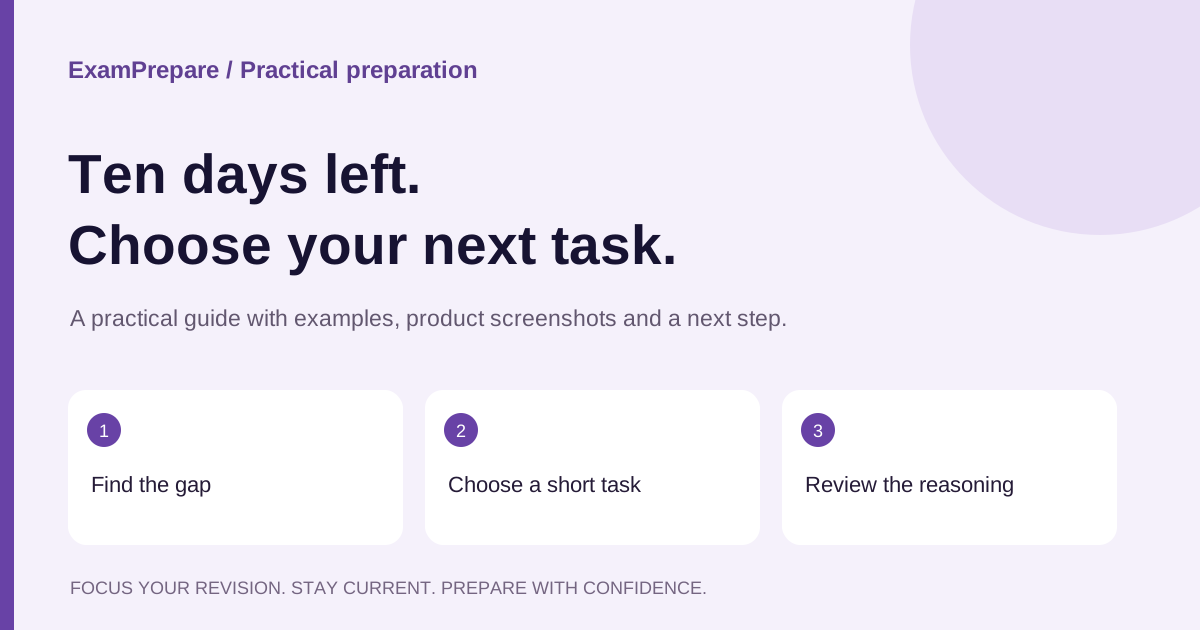
Use the current official objectives and divide your notes into three groups: can demonstrate, uncertain, and not yet attempted. Put a topic in the first group only if you can explain it without the answer in front of you and perform a representative task where appropriate.
An illustrative entry might read: “Network access: can describe the rule, but cannot diagnose why this connection is denied.” That belongs in uncertain, even if you recognised the correct answer in your last practice session. The next task is a small troubleshooting exercise, not another complete reading of the networking chapter.
The revision worksheet gives you columns for the objective, evidence, gap and next action. Start with five rows rather than trying to catalogue everything perfectly.
Stop repeating questions you can no longer assess honestly
When you remember an answer's position before reading the scenario, that question is a poor standalone readiness check. You can still learn from it: hide the answer, explain the deciding requirement, and describe why an alternative fails. Then move to a different scenario or practical task.
Also stop rewriting clean notes, switching between many overlapping courses, and running long practice sessions that leave no time to investigate mistakes. These are candidates for reducing effort, not universal prohibitions. Keep an activity if it is resolving a specific gap you can name.
Give the next ten days distinct jobs
Use this as an adjustable example, not a promise that ten days is enough to prepare from scratch.
- Days 10–8: audit the objectives and repair the largest uncovered areas.
- Days 7–5: work through selected questions and practical exercises for recurring mistakes.
- Days 4–3: rehearse pacing with a session you can also review properly.
- Day 2: revisit unresolved concepts and check exam logistics.
- Day 1: use a short review, prepare your documents and protect your normal rest routine.
If the audit reveals whole domains you cannot yet explain, that is a planning problem rather than a filter problem. Review the provider's rescheduling options before its deadline and choose a date consistent with your preparation.
Build a short session in ExamPrepare
Open your exam overview and choose the sample to inspect the available modes. Practice lets you choose feedback as you work and an optional timer. Exam mode requires a timer and holds results until the end. Full-access question selection depends on your exam and entitlement.
Reserve time to review the session
For a suggested 30-minute block, spend five minutes choosing the task, 15 minutes answering or practising, and ten minutes reviewing. If a question exposes a larger gap, stop and investigate it rather than rushing through the planned count.
Write one sentence beginning “I confused…” and another beginning “Next time I will check…”. For example: “I confused a permission problem with a connectivity problem. Next time I will separate identity, network reachability and resource configuration before choosing a fix.” This example is generic, not a certification answer.
Decide what tomorrow is for
Before closing the library, choose tomorrow's first task. “Revise more” is vague; “explain the difference between these two controls, then test one configuration” is usable. Choose your exam and build that next session around a gap, not a completion counter.
Editorial note: prepared with AI assistance. Timetables and examples are suggested exercises, not measured learner outcomes or guarantees of readiness.