
The 1,000-Question Trap: When More Exam Questions Stop Helping
A large exam question bank gives you plenty to review. The trap is treating the number completed as your main evidence of progress. Look at the source of the questions, how answers are reviewed and which items remain active, then make each session resolve a specific gap.
- Written byExamPrepare Team
- Published on
Look for a stalled learning loop
Review your last few sessions. Can you name a concept you understand better, a mistake you corrected, or a practical task you can now perform? If your notes contain only scores and completion totals, you may be measuring activity without seeing what it changed.
Three warning signs are recognising answers before reading the scenario, repeatedly missing the same distinction, and skipping explanations to keep a daily question target. These are reasons to change the session, not proof that more practice is always harmful.
Run a five-question depth check
Choose questions with a clear source and review process. ExamPrepare records questions and candidate-selected answers from real exam sittings, then has subject matter expert trainers review each question and answer before publication. The benefit comes from reviewing the reasoning, not copying whichever answer a candidate selected.
Choose five questions from different topics where possible. For each one, answer before revealing the reviewed answer. Explain the requirement that decides the choice and why the closest alternative falls short. Then identify a change to the scenario that might change your decision.
Put any uncertain explanation in the answer-confidence worksheet. A correct answer with weak reasoning still produces a useful next task. A wrong answer you can now explain may represent more progress than another familiar correct answer.
Replace a volume target with an outcome
Instead of “finish 100 questions,” try “explain when these two approaches are appropriate, test one example, and revisit the mistakes.” Keep the outcome small enough for your available time.
Here is an illustrative 30-minute session:
- Five minutes: choose one recurring misconception.
- Ten minutes: work through a small relevant selection.
- Ten minutes: check the reasoning against documentation or a practical task.
- Five minutes: record the rule and tomorrow's retrieval prompt.
The timings are an example. Spend longer on the practical step when the skill requires it; do not force an unresolved issue into a five-minute slot merely to keep the schedule neat.
Use product controls to support the outcome
ExamPrepare's reading options let you control how answer feedback appears. Purchased access offers additional selection controls. Use a question range to make the session manageable. On qualifying Hot Exams, Hot Questions select questions seen in the latest 10 real exam sittings within 30 days; Recent Questions offer a 7-, 15- or 30-day window. Use these as starting points while keeping uncovered objectives in your plan.
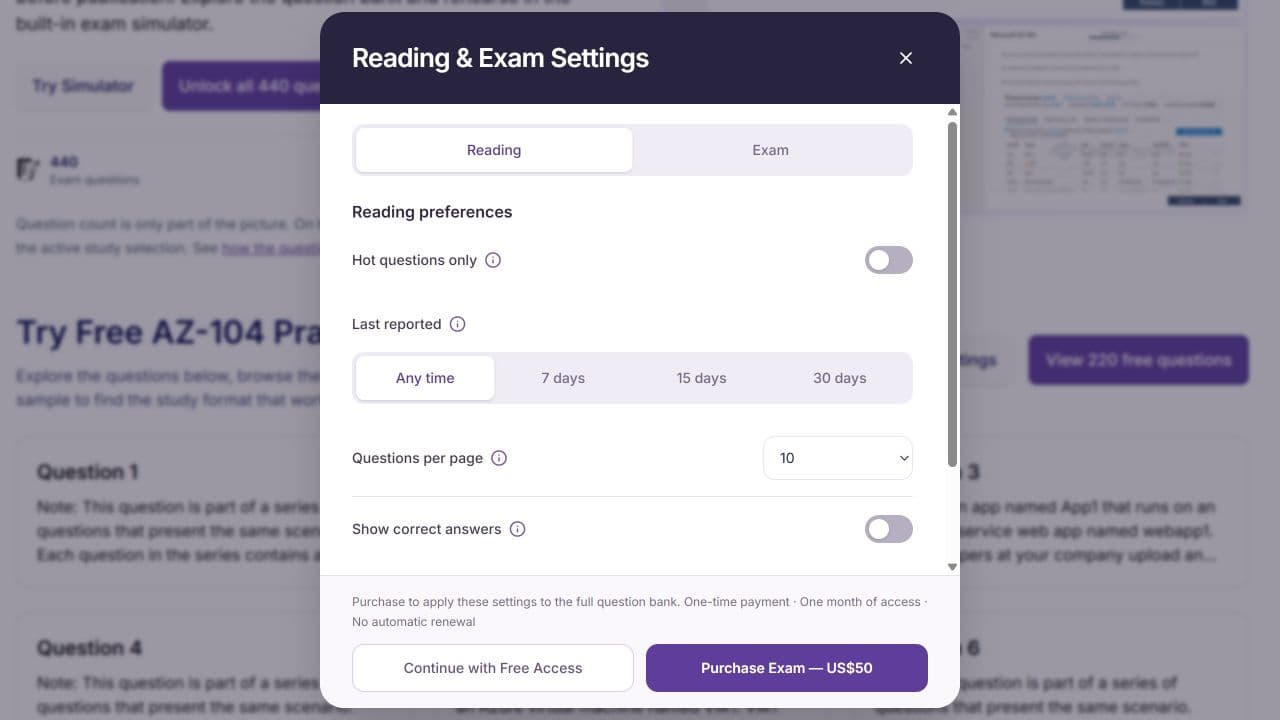
Current Reading & Exam Settings, captured on 10 November 2026. The Reading tab shows Hot Questions, Last reported, questions per page and answer visibility. Applying settings to the full bank requires purchased access.
For a pacing check, move into the built-in exam simulator and leave time to review the results. Simulator attempts are study activity; they do not count as real exam sightings.
Keep breadth in your plan
A focused session should sit inside a wider objective checklist. A small selection can be useful while still missing a whole domain. Check the certification provider's current guide and periodically practise across areas you have not touched recently.
Question count is also not a like-for-like comparison between providers. Banks can differ in duplication, explanation quality, format and topic coverage. Ask what each resource helps you learn and how its maintenance is explained. Do not assume a larger or smaller total proves quality by itself.
ExamPrepare’s active count also reflects maintenance on qualifying Hot Exams: questions unseen for more than 30 days leave active reading and new attempts while their records remain stored. That can leave a shorter practice list without meaning the database has stopped being maintained. Use the smaller selection to focus your next task, and continue checking breadth against the official objectives.
Decide when to move on
Move on when you can explain the principle, distinguish a close alternative and apply it to a suitable new example. Return later to check whether that understanding remains available without your notes. If you cannot yet do those things, choose a clearer explanation or practical exercise rather than repeating the same answer sequence.
Choose your next practice session around one outcome you can describe. The number in the headline is illustrative; there is no universal ideal question count.
Editorial note: prepared with AI assistance. This article offers a study workflow, not a measured comparison of learning products or a guaranteed preparation duration.