
logo

The Open Group OGEA-102: Übungsfragen und geprüfte Antworten

Bereite dich mit fachlich geprüften Fragen und Antworten auf OGEA-102 vor. Probiere kostenlose Fragen aus, erkenne Wissenslücken und trainiere deine Zeiteinteilung im Prüfungssimulator.

55
Übungsfragen

Die Fragenzahl ist nur ein Kriterium. Bei Hot Exams verlassen lange nicht mehr erfasste Fragen die aktive Lernauswahl. So wird die Sammlung gepflegt.
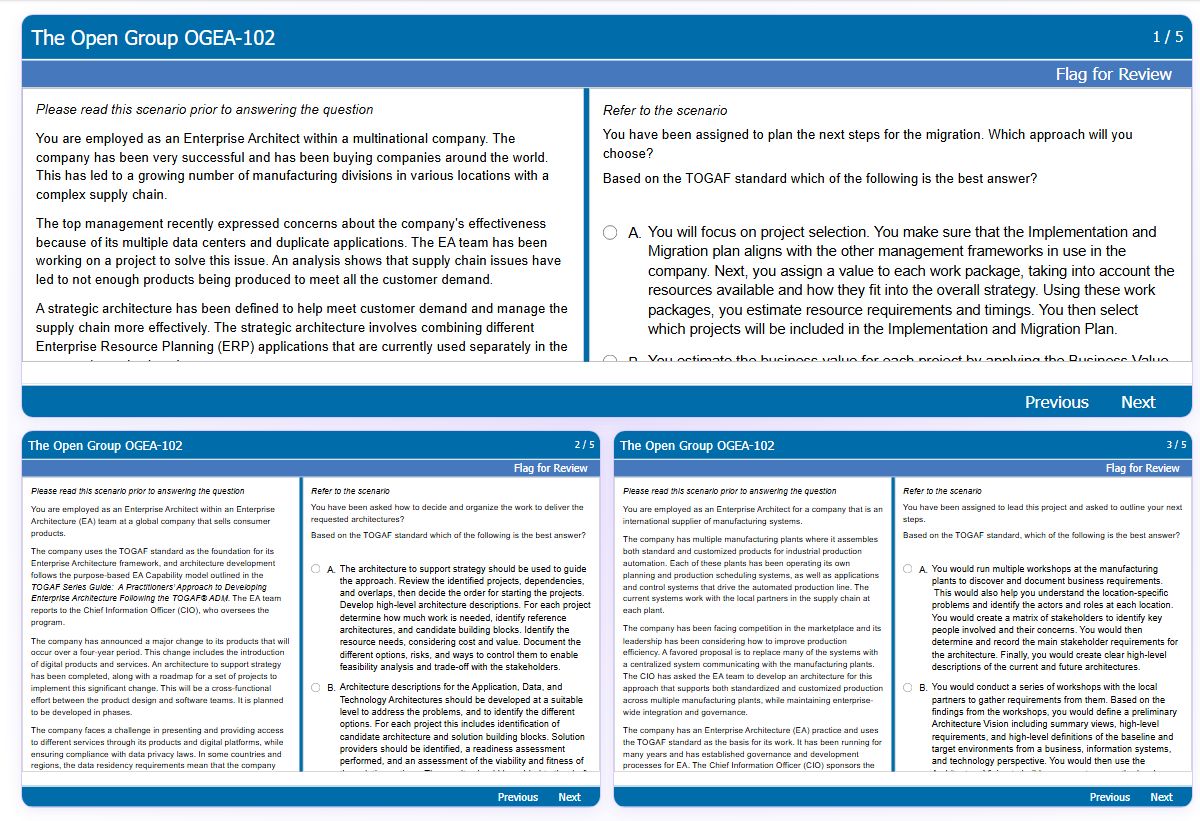
Vorschauen aus dem TOGAF OGEA-102 kostenlosen Simulator-Beispiel

Kostenlose Übungsfragen für OGEA-102 testen

Sieh dir die Fragen unten an, öffne die Fragensammlung oder teste das kostenlose Simulatorbeispiel mit fünf Fragen, um deine Lernmethode zu wählen.

27 kostenlose Fragen ansehen
Frage 1
Please read this scenario prior to answering the question You are working as an Enterprise Architect within an Enterprise Architecture (EA) team at an electric vehicle manufacturer. The company produces electric cars, and battery systems. The goal of the company is to build the best technology and software platform for electric vehicles. The company has decided to introduce a major change to its vehicle design over a five-year period. This will be a cross-functional effort between hardware and software teams, delivering significant new features in the vehicles they manufacture. It is planned to be developed in phases. An architecture to support strategy has been completed with a roadmap for a set of projects. The EA team has inherited the architecture for the hardware and software automotive platform used by current vehicles, some of which can be carried over to the new vehicle design. The EA team has started to define which parts of the architecture to carry forward. The presentation and access to different variations of data that the company plans to offer through its vehicles creates an architecture challenge. The application portfolio and supporting infrastructure must connect with multiple cloud services and data repositories in different countries to be able to handle the data at a large scale. Enough of the Business Architecture has been defined, so that work can commence on the Information Systems and Technology Architectures. Those architectures need to be defined to support the primary business services that the company plans to provide. These services will manage and process the data created by vehicles, paving the way for self-driving vehicles in the future. The company uses the TOGAF Standard as the basis for its Enterprise Architecture framework. The EA team reports to the Chief Technical Officer (CTO), who is the sponsor of the EA program. The CTO requires that the EA team follow the purpose-based EA Capability model as described in the TOGAF Series Guide: A Practitioners’ Approach to Developing Enterprise Architecture Following the TOGAF® ADM . Refer to the scenario You have been asked how to decide and organize the work to deliver the requested architectures? Based on the TOGAF standard which of the following is the best answer?
Frage 2
Please read this scenario prior to answering the question You are working as an Enterprise Architect at a large supermarket. The company runs many retail stores, as well as an online grocery shop. Many of the stores used to remain open 24/7, but the number has decreased in recent years. Instead, they now focus on fulfilling online orders during the night. The company has a mature Enterprise Architecture (EA) practice and uses the TOGAF standard for its architecture development method. The EA practice is involved in all aspects of the business, with oversight provided by an Architecture Board with representatives from different parts of the business. The EA program is sponsored by the Chief Information Officer (CIO). Each store uses a standard method to track sales and inventory. This involves sending accurate timely sales data to a central AI-based inventory management system that can predict demand, adjust stock levels and automate reordering. The central inventory management system is housed at the company’s central data center. The company has bought a major rival. The Chief Executive Officer believes that a merger will enable growth through combined offerings and cost savings. The decision has been taken to fully integrate the two organizations, including merging retail operations and systems. This means that duplicated systems will be replaced with one standard retail management system. Also, the company will reduce the number of applications that are used. The CIO expects significant savings will be achieved by implementing these changes across the newly merged company. One improvement that the rival has successfully implemented is the use of hand-held devices within stores, for both customers and staff. This has increased both customer and staff employee satisfaction due to the time savings this has brought. The CIO has given the go-ahead to roll out the devices in all stores but has stated that training on how to use the hand-held devices should be brief because there are a lot of employees, many of whom are part-time. The Request for Architecture Work to oversee the merger has been approved. The project has been scoped and you have been assigned to work on it. Your role includes managing the architecture for the retail stores. Refer to the scenario You have been asked to confirm the most relevant architecture principles for the transformation. Based on the TOGAF Standard, which of the following is the best answer? [Note: The sequence of the principles listed in each answer does not matter. You should assume the company follows the set of principles that are provided in the TOGAF Standard, ADM Techniques, Architecture Principles chapter. You may need to refer to section 2.6 located in ADM Techniques within the reference text to answer this question.]
Frage 3
Please read this scenario prior to answering the question You are working as an Enterprise Architect for a company that supplies products for industrial production automation. You are part of an Enterprise Architecture (EA) team that has responsibilities across the company. The company has multiple manufacturing plants where it assembles both standard and customized products. Each of these plants operates its own planning and production scheduling systems, as well as applications and control systems that drive the automated production line. During a recent management meeting, a senior Vice-President mentioned an interview where a competitor company’s CIO explained how they had improved their production efficiency. Multiple planning and scheduling systems had been replaced by single system in a cloud-based data center. Some discussion followed, and the CIO explained that the situations are not comparable as the company’s current systems architecture is already optimized. As the competitor has reported better financial results, the CEO has asked to investigate the cloud-based solution. In response, the Architecture Board approved a Request for Architecture Work to find out if such an architecture transformation would lead to efficiency improvements. You have been asked to help the architecture team with this project. A concern of the plant managers is the safety and dependability of using a remote centralized system for planning and scheduling production. The system they choose must also be able to work with the local partners in the supply chain at each plant. The company has an Enterprise Architecture (EA) practice and uses the TOGAF Standard as the basis for its work. It has been running for many years and has established governance and development processes for EA. The Chief Information Officer (CIO) sponsors the Enterprise Architecture program. Refer to the scenario You have been asked to describe how you will start the architecture project. Based on the TOGAF Standard, which of the following is the best answer?
Frage 4
Please read this scenario prior to answering the question You are working as an Enterprise Architect within a healthcare and life science company. The company is a leading player in its industry, dedicated to transforming healthcare with new ideas and advancements. The company has multiple divisions that cover different aspects of the business. The company’s Enterprise Architecture (EA) department has been operating for several years and has mature, well-developed architecture governance and development processes following the TOGAF Standard. In addition to the EA program, the company has a number of management frameworks in use. The Architecture Board includes representatives from each division of the company. Many of the company’s rivals have begun utilizing Artificial Intelligence (AI) in their operations, and the indications are that this will be transformative for healthcare delivery. This is something the EA department has been interested in for a while, and they had recently submitted an architecture Change Request which was approved. As a result, the CIO has approved a Request for Architecture Work to investigate the implementation of AI in the company. Areas for evaluation include: How can staff use AI daily in their current role? How AI can enhance access to care for patients, and how to make that experience seamless? How AI can offer new workplace platforms and tools to increase efficiency? Some of the top managers are worried about a change in the way of working, and if it will achieve the goals. Many are not confident that the company’s risk management processes are adequate for a company-wide integration of generative AI. There are also questions from staff about whether enough specific guidelines and polices have been put in place for responsible use of AI. The Chief Information Officer (CIO) is the sponsor of the Enterprise Architecture program. The CIO has actively encouraged architecting with agility within the EA department as her preferred approach for projects. The CIO wants to know how to address these concerns and reduce risks. Refer to the scenario You have been tasked with starting the architecture development. How do you begin? Based on the TOGAF standard which of the following is the best answer?
Frage 5
Please read this scenario prior to answering the question You are working as an Enterprise Architect within an Enterprise Architecture (EA) project team at a multinational energy company. The company is committed to becoming a net-zero emissions energy business by 2050. To achieve this, the company is focusing on a shift to production of renewable energy and adopting eco-friendly practices. The company has an established EA practice and follows the TOGAF Standard for its Enterprise Architecture framework. The EA team oversees all the major projects in the company. The EA team reports to the Chief Technical Officer (CTO), who is the sponsor of the EA program. The Architecture Board is made up of senior leaders from all parts of the company. The company is starting to invest in developing various kinds of renewable energy projects, including solar, and wind. A large part of the growth in its renewable energy portfolio has come from buying other companies. The company is keen on acquiring small startups and mid-size companies to leverage their technical innovations. This way, the company aims to outperform its competitors, scale rapidly, and establish a presence in new markets. The existing business and the newly acquired companies are not working well together, which increasingly causes problems. In response, a strategic plan was created and approved. The plan aims to make the merged companies work more effectively together. This will save money by sharing their common assets, including fixed capital assets, research and development facilities, and resources. The EA team have been asked to oversee the transformation to carry out the strategic plan. The goal is to strengthen the company’s position in the market and reduce costs by taking advantage of economies of scale. The Chief Executive Officer (CEO) has stated that to stay competitive and relevant, the company must transform or entirely reinvent its business model. A Request for Architecture Work for the project has created and has been approved. Refer to the Scenario As the EA team begins its work on the transformation, the EA team leader wants to know what needs to be done to make sure that the company succeeds with the proposed changes and how to manage any risks. Based on the TOGAF Standard, which of the following is the best answer?
Frage 6
Please read this scenario prior to answering the question You are an Enterprise Architect working within a large company that operates globally. The company has been very successful and has made acquisitions around the world. It has led to a growing number of manufacturing divisions in many locations with a complex supply chain. Senior management recently expressed concerns about the company's effectiveness because of its multiple data centers and duplicate applications. The EA team has been working on a project to solve this issue. An analysis shows that supply chain issues have led to not enough products being produced to meet all the customer demand. A strategic architecture has been defined to help meet customer demand and manage the supply chain more effectively. The strategic architecture involves combining different Enterprise Resource Planning (ERP) applications that are currently used separately in the company’s production sites. Each division has finished the Architecture Definition documentation to address their own specific manufacturing needs. The enterprise architects have defined a set of work packages that address the gaps found. They have noted the value produced, work needed, and dependencies between work packages to achieve a target architecture for adding a new ERP environment into the company. Because of the risks posed by this change from the current environment, the architects have recommended that a phased approach should be taken to implement the target architecture with several stages of change. The entire implementation process is estimated to take over two years. The company has an established Enterprise Architecture (EA) practice and follows the TOGAF Architecture Development Method. The company also uses various management frameworks such as business planning, project/portfolio management, and operations management. The EA program is sponsored by the Chief Information Officer (CIO). In your role as an Enterprise Architect within the EA team, you work closely with the important stakeholders from the various divisions within the company. Refer to the scenario You have been asked about the next steps in planning the migration. Based on the TOGAF standard which of the following is the best answer?

Laden Sie OGEA-102 Beispielfragen herunter

Lade bis zu 10 unterstützte Einfach- oder Mehrfachauswahlfragen mit erfassten Antworten aus den letzten fünf aufgezeichneten Sitzungen herunter. Das Beispiel nutzt zuerst die kostenlose Hälfte und bei Bedarf anschließend die kostenpflichtige Hälfte.

Lernwerkzeuge für deine Vorbereitung auf OGEA-102

Beginne mit einem kostenlosen Beispiel und wähle die passenden Lernwerkzeuge. Bezahlter Zugang gilt für die gewählte Prüfung während der Laufzeit deines Plans.

Wissen mit geprüften Antworten kontrollieren

Lerne mit Antworten, die Fachtrainer vor der Veröffentlichung geprüft haben. Du musst dich dafür nicht auf lange Kommentardiskussionen verlassen. Nutze Kommentare, um Begründungen zu verstehen oder Korrekturen anzufragen.

Zeiteinteilung im Simulator trainieren

Wähle Practice oder Exam mit Zeitlimit und filtere nach Fragetyp und Bereich. Wiederhole ausgewählte falsche Antworten aus bis zu deinen letzten fünf abgeschlossenen Exam-Versuchen derselben Prüfung. Unbeantwortete Fragen sind ausgeschlossen.

Lesen und Wiederholen anpassen

Wähle 6, 10, 25, 50 oder 100 Fragen pro Seite, einen Bereich und die Antwortanzeige. Hot Exams bieten außerdem Hot Questions und Sichtungen der letzten 7, 15 oder 30 Tage. Die ältesten erstmals erfassten Fragen erscheinen zuerst.

Einzelne Fragen diskutieren

Stelle Fragen zu einzelnen Aufgaben, vergleiche Begründungen und stimme für eine Antwort. Nutze die Diskussion ergänzend zur fachlichen Prüfung vor der Veröffentlichung.

Mit PDF-Dateien offline wiederholen

Probiere ein kostenloses PDF mit bis zu 10 Fragen aus. Bezahlter Lesezugang ermöglicht auch den Export unterstützter Einfach- und Mehrfachauswahlfragen mit Antworten und Bildern. Interaktive Formate bleiben auf der Website.

Deinen Prüfungszugang verwalten

Nutze die vollständige Fragensammlung und die Simulationsfunktionen deiner gekauften Prüfung ohne CAPTCHA. Deine Prüfungen, Lernlinks und Ablaufdaten findest du im Profil.

TOGAF Enterprise Architecture Part 2

Prüfungsthemen und Lernplan für OGEA-102

Geprüfte Fähigkeiten

Nutze die Themen aus dem verlinkten offiziellen Leitfaden für deine Vorbereitung auf OGEA-102. Prüfungsziele können sich ändern. Prüfe deshalb vor der Anmeldung die aktuell gültige Fassung.

  • Der Kontext der Unternehmensarchitektur
  • Management von Stakeholdern
  • Phase A, der Ausgangspunkt
  • Architekturentwicklung (Phasen B, C, D)
  • Implementierung der Architektur (Phasen E, F, G)
  • Management von Architekturänderungen (Phase H)
  • Verwaltung der Anforderungen
  • Unterstützung der ADM-Arbeit

Empfohlene Erfahrung vor dem Einstieg

Prüfe vor der Vorbereitung auf OGEA-102 die aktuellen Teilnahmevoraussetzungen und Erfahrungsempfehlungen von The Open Group. Vergleiche die offiziellen Prüfungsziele mit deiner Berufspraxis und plane praktische Übungen für die Bereiche ein, die du noch vertiefen musst.

Plane deine Wiederholung

Vorgeschlagene Vorbereitungssequenz; passen Sie das Tempo an Ihre Erfahrung an.

  1. 1

    Prüfen Sie die aktuellen Ziele

    Erstelle aus den offiziellen Prüfungszielen für OGEA-102 eine Checkliste und markiere die Fähigkeiten, die du bereits praktisch nachweisen kannst.

  2. 2

    Entwickeln Sie Verständnis

    Bearbeite ein Prüfungsziel nach dem anderen. Nutze offizielle Dokumentation und praktische Übungen, um Wissenslücken zu schließen.

  3. 3

    Übe und überprüfe

    Prüfe dein Verständnis mit den Übungsfragen für OGEA-102. Wiederhole vor dem nächsten Schritt, warum die jeweilige Antwort richtig ist.

  4. 4

    Proben Sie und schauen Sie es sich noch einmal an

    Mit bezahltem Zugang kannst du eine Prüfungssimulation mit Zeitlimit durchführen. Wiederhole vor der Prüfungsanmeldung schwächere Themen und praktische Übungen.

Offizielle Ressourcen für das The Open Group Studium

Dieses Datum bezieht sich auf den Prüfungsleitfaden, nicht auf das Prüfungsdatum jeder Frage.

Häufige Fragen zu Vorbereitung und Zugang für OGEA-102

Informiere dich über Prüfung, Lernfunktionen und Zugang, bevor du den nächsten Schritt wählst.

Wer prüft die Fragen und Antworten?

Fachtrainer des jeweiligen Themengebiets prüfen jede Frage und Antwort, bevor sie in die ExamPrepare-Datenbank gelangt. Abstimmungen und Diskussionen ergänzen nach der Veröffentlichung weitere Perspektiven; sie ersetzen diese Prüfung nicht. Mehr dazu in unserer Prüfmethodik.

Warum kann eine kleinere Fragensammlung trotzdem gepflegt sein?

Eine kleinere aktive Sammlung bedeutet nicht automatisch eine veraltete Datenbank. ExamPrepare beobachtet die Sammlung täglich. Bei qualifizierten Hot Exams verlassen seit über 30 Tagen nicht mehr gesichtete Fragen die aktive Leseansicht und neue Simulatorversuche. Ihre Datensätze bleiben gespeichert und können nach neuer Sichtung zurückkehren. Das hält lange inaktive Aufgaben aus der aktuellen Auswahl. Vergleiche neben der Anzahl auch Themenabdeckung, Prüfung und Pflege, und lerne weiterhin anhand der offiziellen Ziele. Eine kleinere Zahl allein beweist weder vollständige Abdeckung noch Prüfungsreife.

Warum gibt es viele Antwortberichte, aber wenige Kommentare?

Fachtrainer prüfen Fragen und Antworten vor der Veröffentlichung; eine lange Diskussion ist keine Voraussetzung für die geprüfte Antwort. Importierte Antwortberichte werden getrennt von Abstimmungen und Kommentaren auf der Website aggregiert. Deshalb können viele gemeldete Antworten einer kleinen Diskussion gegenüberstehen. Nutze Kommentare für Lösungswege, Rückfragen und Korrekturhinweise. Wenige Kommentare beweisen keine Richtigkeit, und eine Mehrheitsabstimmung ersetzt keine fachliche Prüfung.

Wie nah kommt der Simulator einer Prüfung?

Practice bietet einen optionalen Timer und einstellbare Antwort-Rückmeldungen. Exam verlangt einen Timer und zeigt Antworten erst nach Abschluss. Beide Modi unterstützen eigene Aufgabentypen, Bereiche und Fragenzahlen. Eigene Versuche sind auf 200 Fragen begrenzt; vollständige geprüfte Prüfungsvoreinstellungen können mehr verlangen. Standardvoreinstellungen verwenden gespeicherte Prüfungsdaten oder offizielle Anbieterangaben; geschätzte Fragenzahlen sind gekennzeichnet. Sitzungsbasierte Voreinstellungen prüfen die letzten zehn hochgeladenen Sitzungen, benötigen eine exakte Gesamtzahl und mindestens 90 % verwendbare erfasste Fragen; höchstens 10 % werden aus kompatiblen Sitzungen ergänzt. Fehlen notwendige Einstellungen oder Aufgaben, bleibt die Voreinstellung verborgen. Für die Zeitberechnung verwenden wir den höchsten Starttimer bei der ersten Erfassung von Frage 1 innerhalb der letzten zehn Sitzungen und runden auf volle Minuten auf. Spätere Aufrufe, Umfragen, Tutorials und Pausen zählen nicht. Fehlt der Starttimer, dienen ausdrücklich angegebene Prüfungszeiten oder offizielle Zeitvorgaben als Ersatz.

Was sind Hot Questions?

Hot Exams haben innerhalb von 30 Tagen erfasste Sitzungen von mindestens zehn unterschiedlichen Personen. Hot Questions sind Aufgaben aus einer der letzten zehn qualifizierten Sitzungen, mit einer Sitzung je Person. Antwortabstimmungen bestimmen den Filter nicht. Nutze das Signal zusammen mit den Prüfungszielen und deinen schwächeren Themen; es sagt keine zukünftigen Prüfungsinhalte voraus.

Kann ich Fragen ohne Simulation lesen?

Der kostenpflichtige Lesezugang bietet 6, 10, 25, 50 oder 100 Fragen pro Seite, auswählbare Bereiche und sichtbare Antworten. Bei Hot Exams kommen die Filter Hot questions only und Seen within 7, 15 or 30 days hinzu. Kombiniere Filter für eine gezielte Auswahl. Verfügbare Fragen erscheinen nach ihrem ursprünglichen Erfassungsdatum, die ältesten zuerst und neue am Ende.

Kann ich Fragen und Antworten als PDF herunterladen?

Jede Prüfungsübersicht bietet ein kostenloses PDF-Beispiel mit bis zu zehn unterstützten Fragen. Mit kostenpflichtigem Lesezugang kannst du unterstützte Single- und Multiple-Choice-Fragen samt Antworten und Bildern exportieren. Interaktive Aufgaben benötigen die Website und sind im PDF keine interaktiven Übungen.

Wie hängen Abstimmungen und Diskussionen mit geprüften Antworten zusammen?

Fachtrainer prüfen Fragen und Antworten vor der Veröffentlichung. Importierte Antwortberichte enthalten zusammengefasste Antworten; Abstimmungen und Kommentare auf der Website zeigen die Beteiligung auf ExamPrepare. Vergleiche Argumente und untersuche Unstimmigkeiten in der Diskussion. Eine Mehrheit allein beweist keine richtige Antwort.

Was schaltet ein Kauf frei?

Ein Kauf umfasst die vollständige Fragensammlung der gewählten Prüfung, Zugang ohne CAPTCHA, Lesefunktionen, unterstützte PDF-Exporte sowie vollständige Practice- und zeitgesteuerte Exam-Funktionen. Er gilt für diese Prüfung und die Laufzeit deines gewählten Tarifs, nicht für sämtliche Zertifizierungen im Katalog.

Wo finde ich meine gekauften Prüfungen und Ablaufdaten?

Melde dich mit dem beim Kauf verwendeten Konto an und öffne dein Profil. Deine gekaufte Prüfungssammlung zeigt Lernlinks und Ablaufdaten. Dort kannst du weiterlernen und die verbleibende Zugangszeit prüfen.

Alle Fragen anzeigen
bg

Finde deine nächste Übungsprüfung

Wähle eine Zertifizierung und entdecke geprüfte Antworten, kostenlose Beispielfragen und Prüfungssimulationen.