
logo

Domande di esercitazione The Open Group OGEA-102 e risposte verificate

Preparati per OGEA-102 con domande e risposte verificate da esperti. Prova i quesiti gratuiti per individuare gli argomenti da ripassare e allenati a gestire il tempo con il simulatore d’esame.

55
Domande di esercitazione

Il numero di domande è solo uno dei criteri. Negli Hot Exams, i quesiti non segnalati da molto tempo escono dalla selezione attiva. Scopri come viene aggiornata la raccolta.
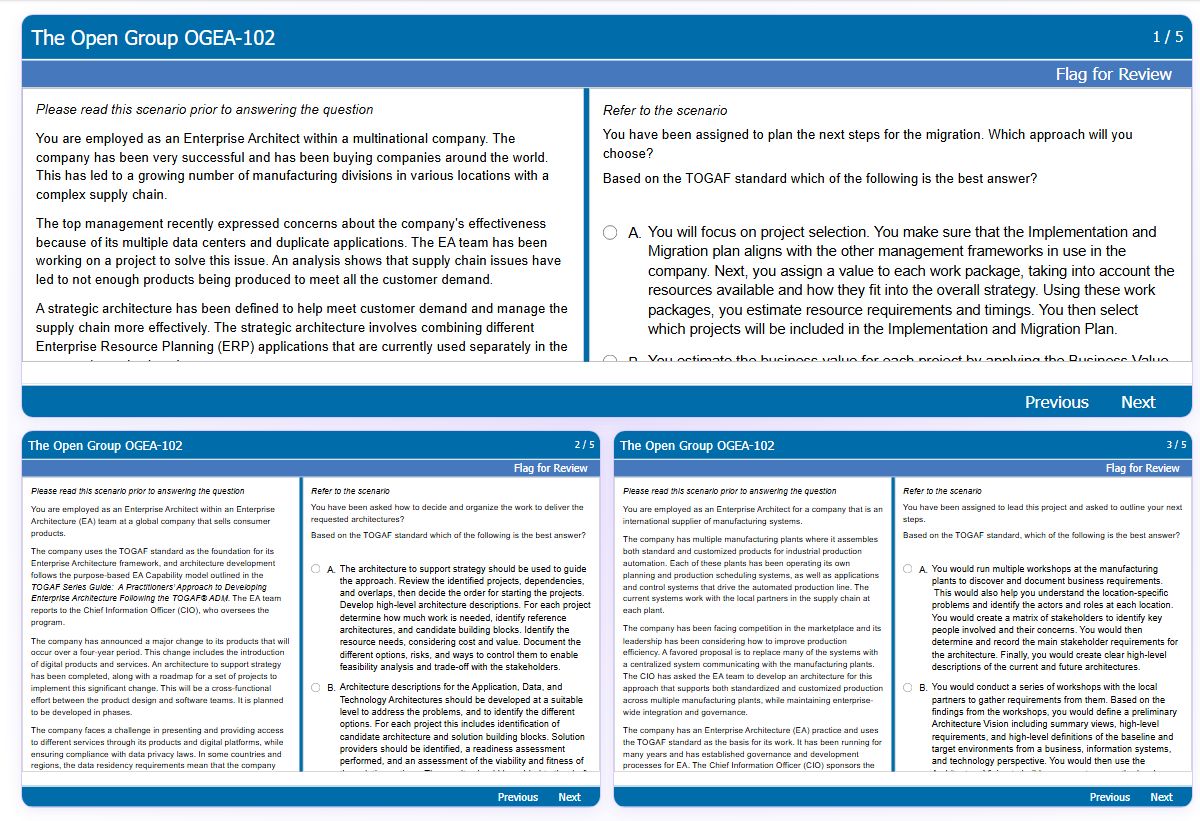
Anteprime tratte dall'esempio TOGAF OGEA-102 gratuito del simulatore

Prova i quesiti gratuiti OGEA-102

Esplora i quesiti qui sotto, consulta la raccolta o prova il simulatore gratuito di cinque domande per scegliere il tuo metodo di studio.

Vedi 27 domande gratuite
Domanda 1
Please read this scenario prior to answering the question You are working as an Enterprise Architect within an Enterprise Architecture (EA) team at an electric vehicle manufacturer. The company produces electric cars, and battery systems. The goal of the company is to build the best technology and software platform for electric vehicles. The company has decided to introduce a major change to its vehicle design over a five-year period. This will be a cross-functional effort between hardware and software teams, delivering significant new features in the vehicles they manufacture. It is planned to be developed in phases. An architecture to support strategy has been completed with a roadmap for a set of projects. The EA team has inherited the architecture for the hardware and software automotive platform used by current vehicles, some of which can be carried over to the new vehicle design. The EA team has started to define which parts of the architecture to carry forward. The presentation and access to different variations of data that the company plans to offer through its vehicles creates an architecture challenge. The application portfolio and supporting infrastructure must connect with multiple cloud services and data repositories in different countries to be able to handle the data at a large scale. Enough of the Business Architecture has been defined, so that work can commence on the Information Systems and Technology Architectures. Those architectures need to be defined to support the primary business services that the company plans to provide. These services will manage and process the data created by vehicles, paving the way for self-driving vehicles in the future. The company uses the TOGAF Standard as the basis for its Enterprise Architecture framework. The EA team reports to the Chief Technical Officer (CTO), who is the sponsor of the EA program. The CTO requires that the EA team follow the purpose-based EA Capability model as described in the TOGAF Series Guide: A Practitioners’ Approach to Developing Enterprise Architecture Following the TOGAF® ADM . Refer to the scenario You have been asked how to decide and organize the work to deliver the requested architectures? Based on the TOGAF standard which of the following is the best answer?
Domanda 2
Please read this scenario prior to answering the question You are working as an Enterprise Architect at a large supermarket. The company runs many retail stores, as well as an online grocery shop. Many of the stores used to remain open 24/7, but the number has decreased in recent years. Instead, they now focus on fulfilling online orders during the night. The company has a mature Enterprise Architecture (EA) practice and uses the TOGAF standard for its architecture development method. The EA practice is involved in all aspects of the business, with oversight provided by an Architecture Board with representatives from different parts of the business. The EA program is sponsored by the Chief Information Officer (CIO). Each store uses a standard method to track sales and inventory. This involves sending accurate timely sales data to a central AI-based inventory management system that can predict demand, adjust stock levels and automate reordering. The central inventory management system is housed at the company’s central data center. The company has bought a major rival. The Chief Executive Officer believes that a merger will enable growth through combined offerings and cost savings. The decision has been taken to fully integrate the two organizations, including merging retail operations and systems. This means that duplicated systems will be replaced with one standard retail management system. Also, the company will reduce the number of applications that are used. The CIO expects significant savings will be achieved by implementing these changes across the newly merged company. One improvement that the rival has successfully implemented is the use of hand-held devices within stores, for both customers and staff. This has increased both customer and staff employee satisfaction due to the time savings this has brought. The CIO has given the go-ahead to roll out the devices in all stores but has stated that training on how to use the hand-held devices should be brief because there are a lot of employees, many of whom are part-time. The Request for Architecture Work to oversee the merger has been approved. The project has been scoped and you have been assigned to work on it. Your role includes managing the architecture for the retail stores. Refer to the scenario You have been asked to confirm the most relevant architecture principles for the transformation. Based on the TOGAF Standard, which of the following is the best answer? [Note: The sequence of the principles listed in each answer does not matter. You should assume the company follows the set of principles that are provided in the TOGAF Standard, ADM Techniques, Architecture Principles chapter. You may need to refer to section 2.6 located in ADM Techniques within the reference text to answer this question.]
Domanda 3
Please read this scenario prior to answering the question You are working as an Enterprise Architect for a company that supplies products for industrial production automation. You are part of an Enterprise Architecture (EA) team that has responsibilities across the company. The company has multiple manufacturing plants where it assembles both standard and customized products. Each of these plants operates its own planning and production scheduling systems, as well as applications and control systems that drive the automated production line. During a recent management meeting, a senior Vice-President mentioned an interview where a competitor company’s CIO explained how they had improved their production efficiency. Multiple planning and scheduling systems had been replaced by single system in a cloud-based data center. Some discussion followed, and the CIO explained that the situations are not comparable as the company’s current systems architecture is already optimized. As the competitor has reported better financial results, the CEO has asked to investigate the cloud-based solution. In response, the Architecture Board approved a Request for Architecture Work to find out if such an architecture transformation would lead to efficiency improvements. You have been asked to help the architecture team with this project. A concern of the plant managers is the safety and dependability of using a remote centralized system for planning and scheduling production. The system they choose must also be able to work with the local partners in the supply chain at each plant. The company has an Enterprise Architecture (EA) practice and uses the TOGAF Standard as the basis for its work. It has been running for many years and has established governance and development processes for EA. The Chief Information Officer (CIO) sponsors the Enterprise Architecture program. Refer to the scenario You have been asked to describe how you will start the architecture project. Based on the TOGAF Standard, which of the following is the best answer?
Domanda 4
Please read this scenario prior to answering the question You are working as an Enterprise Architect within a healthcare and life science company. The company is a leading player in its industry, dedicated to transforming healthcare with new ideas and advancements. The company has multiple divisions that cover different aspects of the business. The company’s Enterprise Architecture (EA) department has been operating for several years and has mature, well-developed architecture governance and development processes following the TOGAF Standard. In addition to the EA program, the company has a number of management frameworks in use. The Architecture Board includes representatives from each division of the company. Many of the company’s rivals have begun utilizing Artificial Intelligence (AI) in their operations, and the indications are that this will be transformative for healthcare delivery. This is something the EA department has been interested in for a while, and they had recently submitted an architecture Change Request which was approved. As a result, the CIO has approved a Request for Architecture Work to investigate the implementation of AI in the company. Areas for evaluation include: How can staff use AI daily in their current role? How AI can enhance access to care for patients, and how to make that experience seamless? How AI can offer new workplace platforms and tools to increase efficiency? Some of the top managers are worried about a change in the way of working, and if it will achieve the goals. Many are not confident that the company’s risk management processes are adequate for a company-wide integration of generative AI. There are also questions from staff about whether enough specific guidelines and polices have been put in place for responsible use of AI. The Chief Information Officer (CIO) is the sponsor of the Enterprise Architecture program. The CIO has actively encouraged architecting with agility within the EA department as her preferred approach for projects. The CIO wants to know how to address these concerns and reduce risks. Refer to the scenario You have been tasked with starting the architecture development. How do you begin? Based on the TOGAF standard which of the following is the best answer?
Domanda 5
Please read this scenario prior to answering the question You are working as an Enterprise Architect within an Enterprise Architecture (EA) project team at a multinational energy company. The company is committed to becoming a net-zero emissions energy business by 2050. To achieve this, the company is focusing on a shift to production of renewable energy and adopting eco-friendly practices. The company has an established EA practice and follows the TOGAF Standard for its Enterprise Architecture framework. The EA team oversees all the major projects in the company. The EA team reports to the Chief Technical Officer (CTO), who is the sponsor of the EA program. The Architecture Board is made up of senior leaders from all parts of the company. The company is starting to invest in developing various kinds of renewable energy projects, including solar, and wind. A large part of the growth in its renewable energy portfolio has come from buying other companies. The company is keen on acquiring small startups and mid-size companies to leverage their technical innovations. This way, the company aims to outperform its competitors, scale rapidly, and establish a presence in new markets. The existing business and the newly acquired companies are not working well together, which increasingly causes problems. In response, a strategic plan was created and approved. The plan aims to make the merged companies work more effectively together. This will save money by sharing their common assets, including fixed capital assets, research and development facilities, and resources. The EA team have been asked to oversee the transformation to carry out the strategic plan. The goal is to strengthen the company’s position in the market and reduce costs by taking advantage of economies of scale. The Chief Executive Officer (CEO) has stated that to stay competitive and relevant, the company must transform or entirely reinvent its business model. A Request for Architecture Work for the project has created and has been approved. Refer to the Scenario As the EA team begins its work on the transformation, the EA team leader wants to know what needs to be done to make sure that the company succeeds with the proposed changes and how to manage any risks. Based on the TOGAF Standard, which of the following is the best answer?
Domanda 6
Please read this scenario prior to answering the question You are an Enterprise Architect working within a large company that operates globally. The company has been very successful and has made acquisitions around the world. It has led to a growing number of manufacturing divisions in many locations with a complex supply chain. Senior management recently expressed concerns about the company's effectiveness because of its multiple data centers and duplicate applications. The EA team has been working on a project to solve this issue. An analysis shows that supply chain issues have led to not enough products being produced to meet all the customer demand. A strategic architecture has been defined to help meet customer demand and manage the supply chain more effectively. The strategic architecture involves combining different Enterprise Resource Planning (ERP) applications that are currently used separately in the company’s production sites. Each division has finished the Architecture Definition documentation to address their own specific manufacturing needs. The enterprise architects have defined a set of work packages that address the gaps found. They have noted the value produced, work needed, and dependencies between work packages to achieve a target architecture for adding a new ERP environment into the company. Because of the risks posed by this change from the current environment, the architects have recommended that a phased approach should be taken to implement the target architecture with several stages of change. The entire implementation process is estimated to take over two years. The company has an established Enterprise Architecture (EA) practice and follows the TOGAF Architecture Development Method. The company also uses various management frameworks such as business planning, project/portfolio management, and operations management. The EA program is sponsored by the Chief Information Officer (CIO). In your role as an Enterprise Architect within the EA team, you work closely with the important stakeholders from the various divisions within the company. Refer to the scenario You have been asked about the next steps in planning the migration. Based on the TOGAF standard which of the following is the best answer?

Scarica le domande OGEA-102 di esempio

Scarica fino a 10 quesiti a scelta singola o multipla supportati, con le risposte registrate, dalle ultime cinque sessioni registrate. Il campione usa prima la metà gratuita, poi quella a pagamento se necessario.

Strumenti per preparare OGEA-102

Inizia con un esempio e scegli gli strumenti adatti al ripasso. L’accesso a pagamento copre l’esame scelto per la durata del piano acquistato.

Verifica le conoscenze con risposte controllate

Studia risposte verificate da formatori esperti prima della pubblicazione, senza dipendere da lunghe discussioni. Usa i commenti per capire il ragionamento o richiedere una correzione.

Allena la gestione del tempo nel simulatore

Scegli Practice o Exam a tempo e filtra per tipo e intervallo. Ripassa le risposte selezionate ma errate delle ultime cinque sessioni Exam completate al massimo per lo stesso esame. Le domande senza risposta sono escluse.

Personalizza lettura e ripasso

Visualizza 6, 10, 25, 50 o 100 domande per pagina, scegli l’intervallo e mostra le risposte. Gli Hot Exams offrono anche Hot Questions e segnalazioni degli ultimi 7, 15 o 30 giorni. L’ordine segue la prima osservazione, dalla più vecchia alla più recente.

Discuti le singole domande

Fai domande su un quesito, confronta i ragionamenti e vota una risposta. Usa il confronto per approfondire insieme alla verifica degli esperti svolta prima della pubblicazione.

Scarica PDF per ripassare offline

Prova un PDF gratuito di massimo 10 quesiti. L’accesso di lettura a pagamento consente anche di esportare i quesiti a scelta singola o multipla supportati, con risposte e immagini. I formati interattivi restano sul sito.

Gestisci l’accesso al tuo esame

Accedi a tutta la raccolta e alle funzioni di simulazione dell’esame acquistato, senza CAPTCHA. Trovi esami, collegamenti di studio e date di scadenza nel tuo profilo.

TOGAF Enterprise Architecture Part 2

Argomenti e piano di studio per OGEA-102

Competenze valutate dall’esame

Usa gli argomenti della guida ufficiale collegata per organizzare la preparazione a OGEA-102. Gli obiettivi possono cambiare: verifica la versione in vigore prima di iscriverti.

  • Il contesto per l'architettura aziendale
  • Gestione degli stakeholder
  • Fase A, il punto di partenza
  • Sviluppo dell'architettura (fasi B, C, D)
  • Implementazione dell'architettura (fasi E, F, G)
  • Gestione delle modifiche all'architettura (fase H)
  • Gestione dei requisiti
  • Supportare il lavoro dell'ADM

Esperienza consigliata prima di iniziare

Prima di preparare OGEA-102, controlla i requisiti di ammissione e l’esperienza consigliata da The Open Group. Confronta gli obiettivi ufficiali con la tua esperienza professionale e pianifica esercitazioni per gli ambiti da rafforzare.

Organizza il ripasso

Sequenza di preparazione consigliata; adatta il ritmo alla tua esperienza.

  1. 1

    Verifica gli obiettivi attuali

    Crea un elenco dagli obiettivi ufficiali di OGEA-102 e segna le competenze che sai già dimostrare.

  2. 2

    Sviluppa la comprensione

    Studia un obiettivo alla volta. Usa la documentazione ufficiale e le esercitazioni pratiche per colmare le lacune.

  3. 3

    Esercitati e ripassa

    Usa i quesiti OGEA-102 per verificare la tua comprensione. Ripassa perché ogni risposta è corretta prima di proseguire.

  4. 4

    Prova e rivisita

    Con un accesso a pagamento, svolgi una simulazione a tempo. Riprendi gli argomenti meno chiari e ripeti le esercitazioni prima di iscriverti all’esame.

Risorse ufficiali per The Open Group lo studio

Questa data si riferisce alla guida all'esame, non alla data di revisione di ogni domanda.

FAQ sulla preparazione e sull’accesso a OGEA-102

Conosci la revisione, gli strumenti e le condizioni di accesso prima di scegliere il prossimo passo.

Chi verifica domande e risposte?

Formatori specialisti di ciascun settore esaminano ogni domanda e risposta prima dell’ingresso nel database ExamPrepare. Voti e discussioni aggiungono prospettive dopo la pubblicazione, senza sostituire il controllo. Leggi la metodologia.

Una banca più piccola può essere comunque aggiornata?

Una raccolta attiva più piccola non implica automaticamente dati obsoleti. ExamPrepare la monitora quotidianamente. Negli Hot Exams idonei, i quesiti non osservati da oltre 30 giorni escono da lettura attiva e nuove simulazioni; restano memorizzati e possono tornare dopo nuove osservazioni. Questo esclude dalla selezione il materiale inattivo da tempo. Valuta copertura, revisione e manutenzione insieme al numero e continua a studiare gli obiettivi ufficiali. Un numero minore non dimostra da solo copertura completa o preparazione sufficiente.

Perché tanti rapporti di risposta ma pochi commenti?

La revisione dei formatori precede la pubblicazione: non serve una lunga discussione per trovare la risposta verificata. I rapporti importati sono aggregati separatamente dai voti e commenti del sito. Una domanda può quindi avere molte risposte segnalate e poco confronto qui. Usa i commenti per capire, chiedere chiarimenti o proporre correzioni. Una discussione silenziosa non prova l’accuratezza e la maggioranza non sostituisce il controllo specialistico.

Quanto è simile il simulatore a un esame?

Practice offre timer facoltativo e feedback configurabile; Exam richiede il timer e mostra le risposte al termine. Entrambi consentono tipi, intervalli e quantità personalizzati. I tentativi personalizzati permettono fino a 200 domande; alcuni preset completi verificati possono richiederne di più. I preset standard riutilizzano impostazioni salvate da metadati acquisiti o fonti ufficiali; i conteggi stimati sono indicati. I preset basati su sessioni esaminano le ultime dieci caricate, richiedono un totale esatto e almeno il 90% di domande utilizzabili e integrano al massimo il 10% da sessioni compatibili. Senza impostazioni o domande necessarie, il preset resta nascosto. La durata stimata usa il timer iniziale più alto alla prima acquisizione della domanda 1 nelle ultime dieci sessioni, arrotondato al minuto superiore. Sono esclusi ritorni successivi, sondaggi, tutorial e pause. Se manca il timer iniziale, si usano durate esplicite o tempi ufficiali.

Che cosa sono le Hot Questions?

Gli Hot Exams hanno sessioni registrate di almeno dieci persone diverse negli ultimi 30 giorni. Le Hot Questions sono presenti in una delle ultime dieci sessioni idonee, una per persona. I voti sulle risposte non determinano il filtro. Usalo insieme agli obiettivi ufficiali e ai tuoi punti deboli: non prevede i contenuti futuri dell’esame.

Posso leggere senza avviare una simulazione?

La lettura a pagamento offre 6, 10, 25, 50 o 100 domande per pagina, intervalli e visibilità delle risposte. Gli Hot Exams aggiungono Hot questions only e Seen within 7, 15 or 30 days. Combina i filtri per restringere la selezione. Le domande sono ordinate dalla prima osservazione più antica alla più recente, con quelle nuove in fondo.

Posso scaricare domande e risposte in PDF?

Ogni pagina d’esame offre un PDF gratuito con un massimo di dieci domande supportate. L’accesso di lettura a pagamento permette anche l’esportazione di quesiti compatibili a risposta singola o multipla, con risposte e immagini. I formati interattivi richiedono il sito e non diventano esercizi interattivi nel PDF.

Come si collegano voti e discussioni alle risposte verificate?

Gli specialisti controllano prima della pubblicazione. I rapporti importati aggregano risposte registrate; i voti e i commenti del sito rappresentano la partecipazione su ExamPrepare. Confronta ragionamenti e approfondisci disaccordi nella discussione: una maggioranza non dimostra da sola la correttezza.

Che cosa sblocca l’acquisto?

Sblocca tutta la banca dell’esame scelto, l’accesso senza CAPTCHA, i controlli di lettura, gli export PDF compatibili e le funzioni complete Practice ed Exam con timer. Copre quell’esame per la durata del piano scelto, non tutte le certificazioni del catalogo.

Dove trovo gli esami acquistati e le scadenze?

Accedi con l’account dell’acquisto e apri il profilo. La libreria personale mostra i collegamenti allo studio e le date di scadenza per riprendere la preparazione e verificare il tempo di accesso restante.

Mostra tutte le domande
bg

Trova il tuo prossimo esame di pratica

Scegli la certificazione ed esplora risposte verificate, domande gratuite e simulazioni d’esame.